

When you look inside a grand piano, your attention is certainly drawn to the massive cast-iron plate and the rows of tensioned strings. You probably rarely pay attention to the narrow wooden strips on which these strings rest. However, these inconspicuous elements are of enormous importance for the instrument’s final sound. It is within them that the secret of the beautiful, deep resonance you hear during concerts is hidden.
What Are Grand Piano Bridges and Why Do They Play a Key Role in the Instrument’s Acoustics?
Grand piano bridges are specially shaped wooden strips that directly transfer the vibrations of the piano strings to the soundboard. They form the most important point of contact between the vibrating wire and the board that amplifies its sound. If any disturbance occurs at this point, the entire system loses its acoustic power and tonal character. For this reason, the acoustics of a grand piano depend to a great extent on the technical condition of these wooden components. Even the best-tuned strings will not sound good if the bridge does not transfer their energy correctly.
How Is a Grand Piano Bridge Constructed?
A grand piano bridge is constructed from a solid block of hardwood into which metal bridge pins are installed and precise notches for the strings are cut. Its construction must withstand enormous physical stresses while at the same time maintaining extraordinary sensitivity to the smallest vibrations. It usually consists of the main bridge body and a bridge cap, which comes into direct contact with the strings. This two-part construction facilitates possible repairs and allows the use of materials with different densities. The entire bridge must fit perfectly to the curvature of the new soundboard in order to ensure maximum sound transmission.

Wood
The primary material used for manufacturing bridges is carefully selected, extremely hard wood such as maple, beech, or hornbeam. The choice of such material results from the need to ensure high resistance to the constant pressure exerted by hundreds of tensioned strings. The hard structure conducts acoustic waves perfectly without damping high frequencies, which is highly desirable in music. Material that is too soft would quickly become deformed, negatively affecting the entire process of sound production. High-quality wood guarantees that the bridge will withstand decades of intensive use without losing its unique acoustic properties.
Bridge Pins
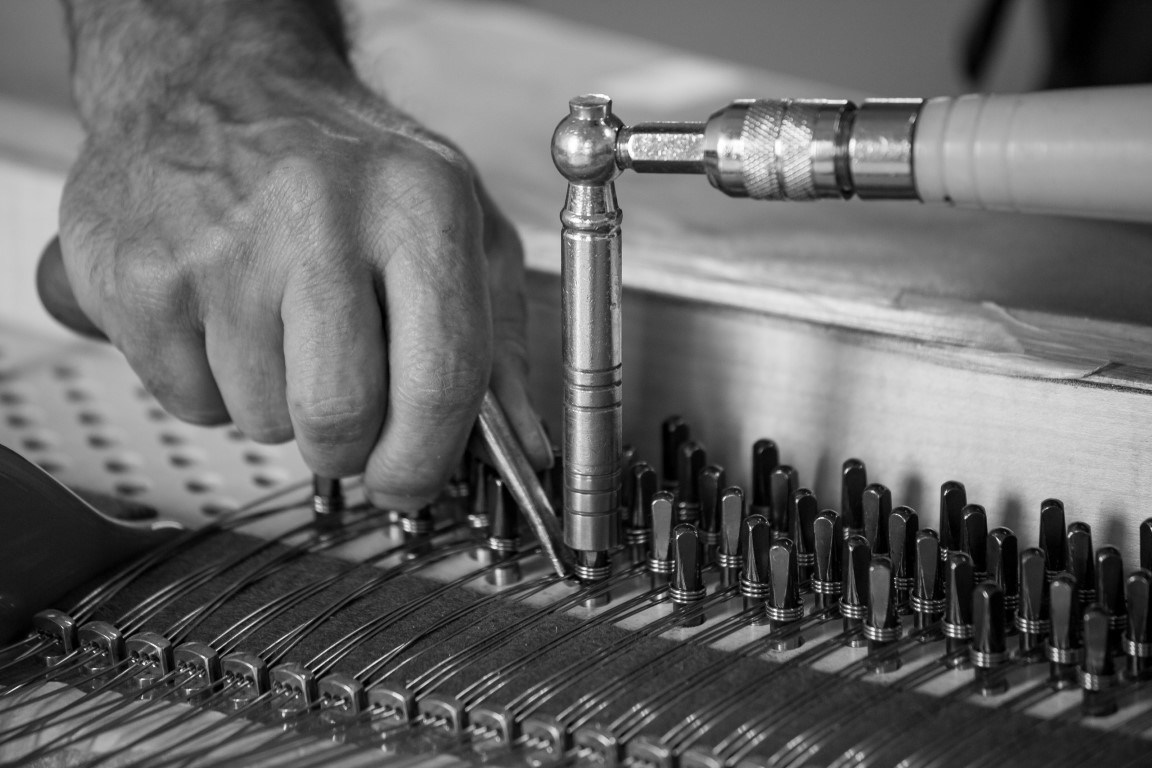
Bridge pins are small metal pins driven into the wooden bridge at the proper angle, determining the exact point where the string rests. Their primary function is to create a slight bend in the string, significantly increasing the pressure against the wooden surface. Thanks to them, the produced tone is clear and unwanted false overtones are completely eliminated when the hammer strikes the string. Over time, these small components may become corroded or loose, requiring the intervention of a qualified specialist. It is worth knowing that professional grand piano restoration often includes replacing all bridge pins in order to restore the instrument’s original purity of tone.
String Bearing Geometry
String bearing geometry is the precise arrangement of angles and distances according to which the metal strings pass over the bridge. Even millimetre deviations from the designer’s specifications may cause neighbouring notes to blend together. The correct routing of the string tension ensures even pressure across the entire bridge surface, protecting the component against one-sided cracking. If you are interested in restoration examples, pay attention to whether the specialists carefully recreate this complex network of contact points. Precise geometry undoubtedly determines whether your instrument will sound clear and well-defined throughout every register. At SAP Renovation, you can be certain of that.
How Do Bridges Transfer Energy to the Soundboard?
Bridges transfer energy to the soundboard through the phenomenon of mechanical coupling, receiving vibrations from the strings and setting the entire board into motion by means of a lever-like action. Because the bridge is firmly glued to the soundboard, even the slightest vibration of the string immediately generates a sound wave within the wood structure. This complex process can easily be compared to a loudspeaker diaphragm, which is moved by the voice coil to produce sound audible to the human ear. The efficiency of this transfer depends on the pressure exerted by the strings. You can read more about the importance of this mechanism in the article: Sound Revival: How the Restoration of Strings, Hammers, and Dampers Affects the Tone of a Grand Piano.
What Types of Bridge Damage Are Most Commonly Found in Old Grand Pianos?
In old grand pianos, the most common types of bridge damage include longitudinal cracks along the line of the bridge pins, loosening of the pins themselves, and separation of the bridge from the soundboard. These phenomena are the result of many years of stress amounting to several tons, often combined with drastic changes in air humidity. Over the decades, natural wood dries out considerably, while traditional hide glues gradually lose their bonding properties. As a result, a number of characteristic structural defects appear, including:
- Delamination of the bridge cap.
- Corrosion damage to the bridge pins.
- Separation of the bridge feet from the bridge body.
If you notice such symptoms, it is worth visiting the SAP Renovation website to learn which repairs are performed most frequently and what determines the scope of the restoration work.
Cracks in the Wood
Cracks in the wood usually appear along the grain, precisely where the holes for the metal bridge pins have been drilled. Such damage causes a dramatic reduction in string pressure, resulting in a dull and unpleasant buzzing sound while playing. This phenomenon occurs particularly often when stable humidity is not maintained in the room during the winter months. Repairing this defect involves precisely milling out the damaged section and gluing in a completely new, healthy insert. Ignoring visible cracks almost always leads to a rapid deterioration in the tuning stability of the entire instrument.
Wear of the Bridge Pin Holes
Wear of the bridge pin holes consists of their irreversible enlargement and deformation as a result of continuous micro-vibrations transmitted by the strings. A loose bridge pin loses its ability to provide firm support for the string, causing a significant portion of the vibrational energy simply to disappear. This results in a substantial reduction in sustain and a noticeable loss of volume within a particular register. To solve this problem, craftsmen enlarge the old holes, glue in special wooden dowels, and drill new, perfectly fitted holes. Such comprehensive grand piano bridge restoration restores the original rigidity of the joint, guaranteeing a powerful and pure sound.
Structural Deformation
Structural deformation usually manifests itself as a flattening of the bridge arch caused by the prolonged pressure of the strings on the more delicate wood structure. When the upper surface loses its original profile, the string pressure decreases noticeably, and the sound becomes flat and completely lacking in tonal colour. In such highly advanced cases, simply sanding the surface is often insufficient to restore the proper acoustic properties. For this reason, specialists very often decide to replace the entire bridge cap with completely new material. We recommend contacting a SAP Renovation expert—our specialists will quickly assess whether your instrument is affected by this particular problem.
Can Bridge Restoration Improve Sound Quality?
Bridge restoration can undoubtedly dramatically improve sound quality by restoring the instrument’s original dynamics and the full richness of its resonance. By carefully removing cracks and restoring the rigidity of the bridge pin holes, the powerful energy of the strings is once again fully transmitted to the soundboard. After such a restoration, owners very often notice that their grand piano has gained an incredibly rich bass and a crystal-clear, highly singing treble. Comprehensive bridge restoration is one of the most effective procedures for improving the instrument’s overall acoustic performance. It is worth reviewing the complete list of services included in our restoration offer to ensure your instrument receives truly comprehensive care.

Bridge Restoration or Manufacturing New Bridges – What Determines the Decision?
The decision whether to restore existing bridges or manufacture completely new ones depends primarily on the degree of wood deterioration and the shape the soundboard has taken over time. If the internal structure of the bridge is still sound and the visible damage is limited only to the bridge pin holes, careful milling and the installation of a new bridge cap are sufficient. However, if the bridge has become permanently deformed or has cracked completely, manufacturing a new replacement becomes absolutely necessary. Experienced craftsmen evaluate every instrument individually using highly advanced measuring equipment. You can learn much more about this fascinating subject by exploring the individual stages of the grand piano restoration process.
Why Does the Precision of Bridge Manufacturing Affect Sound Projection and Sustain?
The precision of bridge manufacturing affects sound projection and sustain because it determines the strength and stability of the connection between the strings and the soundboard. Even the slightest clearance between the bridge pin and the string immediately acts as a natural damper, irreversibly absorbing valuable vibrational energy before it reaches the wood. A perfectly shaped bridge curvature ensures the proper and firm string pressure, allowing the tone to spread freely through the space and sustain for many long seconds. In the field of piano craftsmanship, the relationship between grand piano bridges and tone is completely indisputable. It is precisely this exceptionally rigorous level of woodworking and metalworking precision that makes it possible to unlock the instrument’s full harmonic potential. Every professional acoustic workshop strives to achieve dimensional tolerances measured in tiny fractions of a millimetre during bridge restoration.
Bridges in Steinway, Bösendorfer, and Bechstein Grand Pianos – Are There Structural Differences?
There are significant structural differences between the bridges used in Steinway, Bösendorfer, and Bechstein grand pianos, resulting directly from the different tonal philosophies of these renowned manufacturers. Steinway is well known for frequently using continuous bridges with varying densities, designed to provide a powerful and fully homogeneous response across every register. Bösendorfer, on the other hand, bases its designs on a completely different soundboard construction, which is why its bridges feature distinctive profiles that transmit a warmer and more subtle tonal character. Bechstein instruments, in turn, employ unique bridge segment joints that produce a transparent, bright, and crystal-clear tone in the treble register. Regardless of the prestigious brand, however, each of these exceptional instruments requires extensive expertise and great care when carrying out complex restoration work.
How Is Bridge Restoration Carried Out at SAP Renovation?
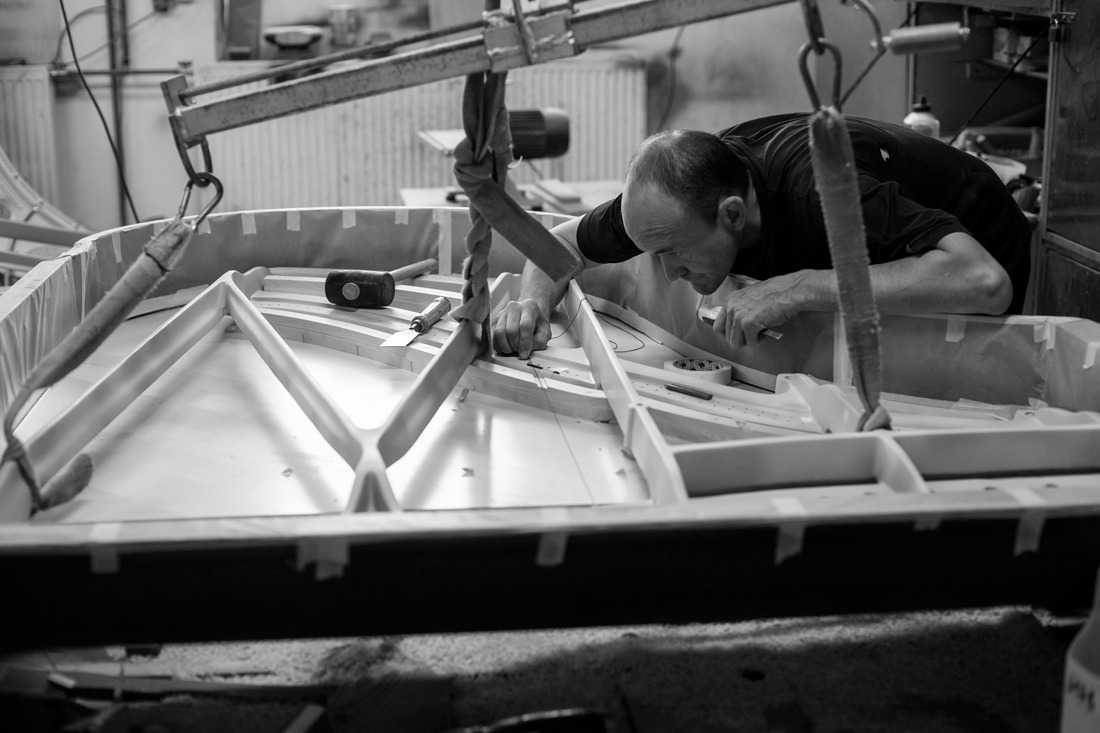
Bridge restoration at SAP Renovation begins with the creation of digital templates that reproduce the original scale design with the highest possible accuracy. The specialists then carefully remove the old bridge structure, thoroughly clean the contact surface, and select seasoned resonant wood with outstanding acoustic properties. The new bridge components are machined on precision CNC equipment before being hand-shaped and carved by experienced master craftsmen. Every bridge pin hole is drilled using specialised templates that guarantee the exact angle for every string, even the smallest one. You can see the results of such precise craftsmanship by browsing the restored grand pianos available for sale in our online gallery.