
Rebuilding a piano does not end when the last screw is tightened. A newly reassembled instrument is still raw artistic material, requiring extensive workshop preparation to realise its full tonal potential. Exceptional sound emerges from the interplay of precision mechanics, the laws of physics and the pianist’s individual musical sensitivity. Only a series of specialist procedures and tests can turn a restored structure into a fully developed instrument for the concert stage.
Restoration complete: why is the piano not yet ready for a concert?
Completing the woodwork and finishing restores the piano’s physical structure, but does not make it acoustically ready. In a newly reassembled grand piano, the wooden and felt components have yet to settle, and substantial loads continue to alter their geometry. The new parts must bed in together during the action’s first hours of operation. Until the structure stabilises, the instrument can quickly lose both its tuning and its carefully adjusted playing characteristics. Taking it on stage without a thorough preparation cycle could compromise the performance.
Stabilising the instrument after reassembling the acoustic structure
Reuniting the cast-iron plate with the rim and bringing the strings up to tension subjects the structure to loads of well over ten tonnes. The assembly rebuilt in the acoustic restoration workshop needs time for these loads to distribute through the soundboard’s wooden structure. Supporting components gradually settle, while the strings’ bearing points on the bridges adjust to minute deformation under tension. The wood responds to every change in stress, making continued observation of the soundboard essential. More precise technical work begins only after this initial settling period.
How do new stringing and tuning pins affect the first weeks of use?
New steel strings and their brass windings naturally stretch under high tension. New tuning pins fitted into a new pinblock also need time to achieve stable seating and the appropriate turning resistance. As a result, stabilising a grand piano’s tuning during the first weeks after rebuilding is an ongoing process that requires repeated attention from a specialist. The metal gradually settles towards a state of mechanical equilibrium. Skipping this stage would make it impossible to maintain clean tuning throughout an intensive concert performance.
Why does a rebuilt grand piano need several tuning adjustments?
Repeatedly bringing the strings back up to pitch is essential because the materials continue to stretch in minute increments. In the first days after restringing, the pitch can fall by more than ten cents overnight. Regular pre-concert piano tuning helps the instrument settle at the string tension corresponding to its target reference pitch, usually A4 = 440 Hz or 442 Hz. Repeated pitch corrections are needed to establish the correct tension in the steel strings. Progressively smaller deviations between tuning sessions indicate that the acoustic structure is becoming more stable.
The first tunings after restoration: gradually reaching the correct pitch
Initial tuning involves raising string tension gradually and evenly across the registers to avoid abrupt loading of the plate. A qualified piano technician initially prioritises an even distribution of load over perfectly refined tuning. Bringing one section up to tension too suddenly could crack the cast-iron plate or damage the soundboard. The load is equalised step by step, allowing the materials time to adapt. Reaching the target pitch is rather like gently waking the instrument from a long sleep.
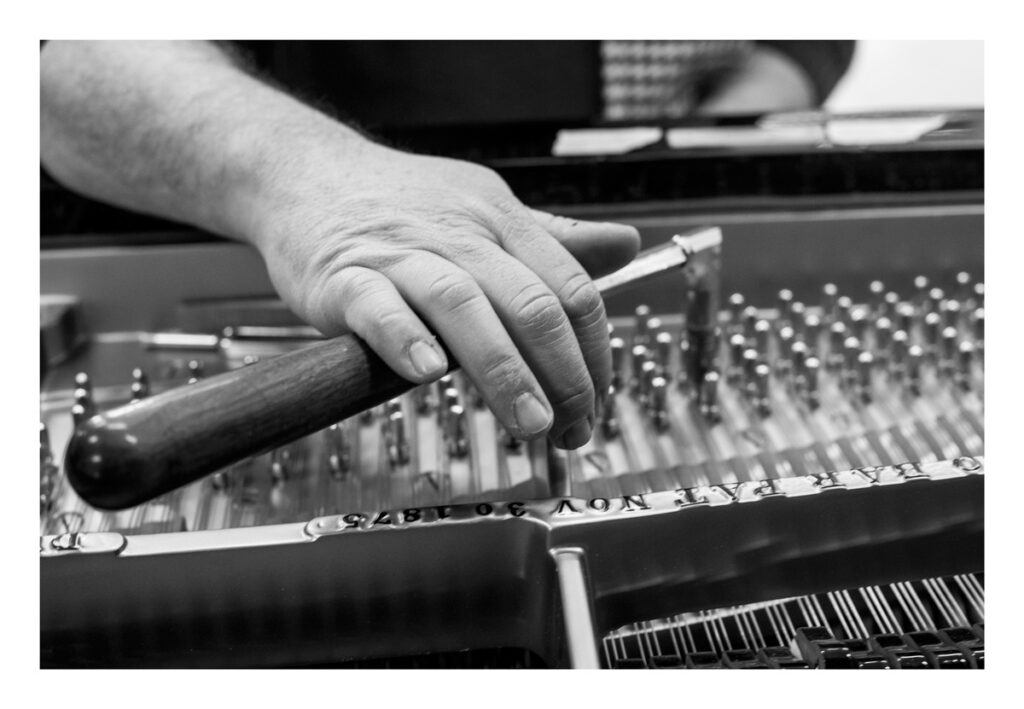
Stabilising the tuning pins, strings and pinblock
The tuning pin’s secure seating in the pinblock is essential to maintaining pitch under powerful hammer blows. The correct turning resistance prevents vibration from allowing the pin to slip. Over time, friction between the wooden pinblock and the metal pin stabilises, providing a firm grip. Precisely seating and aligning the string coils prevents unwanted slack around the tuning pin. This helps the piano hold its pitch even under the demands of expressive playing.
Checking unisons and balance between registers
A coherent tonal result requires close attention to each string within a three-string unison. The strings must vibrate together to avoid unwanted beats and a blurred tone. The technician’s task is to bring the bass, middle and treble registers into a unified tonal whole. Poor balance between registers makes the piano sound uneven and diminishes its natural singing quality. Precisely tuned unisons provide the foundation for a rich, refined sustain.
Regulating the action after playing in the piano
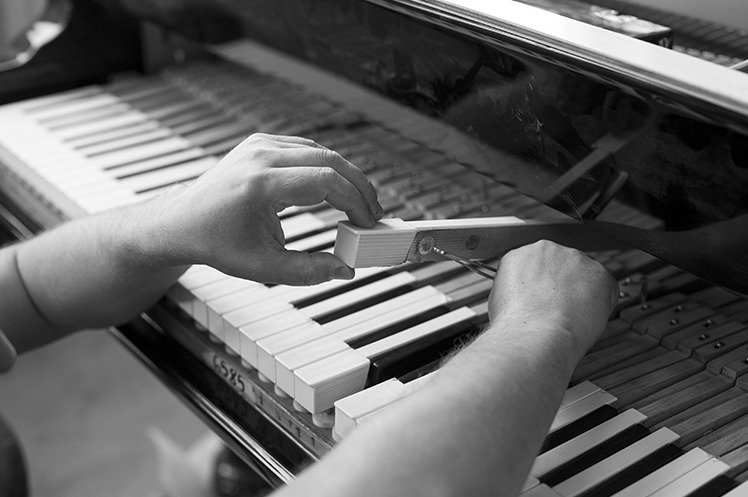
During the first hours of vigorous playing, the restored action naturally beds in. New felt, leather and cloth compress under the levers’ pressure, altering the original settings. Comprehensive action regulation after restoration therefore takes place after a period of use, once these softer materials have settled. Correcting lost motion and key dip restores efficient transmission of force from the pianist’s finger to the string. Without this work, the player would encounter unwanted resistance, imprecision and uneven key travel.
Setting let-off, repetition, checking and hammer return
Minute precision in setting the action is essential for effortless fast passages. Correct let-off prevents the hammer from blocking against the string and allows a clean, immediate rebound. Proper repetition enables another strike without the key returning fully to its rest position. The correct checking distance securely catches the hammer after the strike. These settings must work together across all 88 keys to give the pianist smooth, predictable dynamic control.
Why must new felt and action parts be checked again?
Natural hammer felt and bushing cloth settle during initial use, changing the levers’ contact points. Even the finest components undergo some initial permanent compression under repeated impact. Regular concert piano servicing during the playing-in period includes re-levelling the keys and correcting hammer blow distance. Failing to make these ongoing adjustments would accelerate wear on delicate action parts. Continued monitoring preserves the correct key dip and a responsive touch.
Voicing: shaping the final tonal colour
Specialist piano voicing involves needling the hammer felt to shape the instrument’s individual tonal character. Felt hardness influences whether the sound is bright and incisive or soft, warm and singing. Peter Salisbury’s masterful work provides an outstanding example of how expert treatment of the felt can refine a piano’s tone. Incorrect voicing can irreversibly damage valuable hammers and distort the tonal character. This is the stage at which the instrument acquires its distinctive musical soul. The restoration projects completed at SAP Renovation illustrate the results.
The pianist’s rehearsal: where technical precision meets artistic expectations
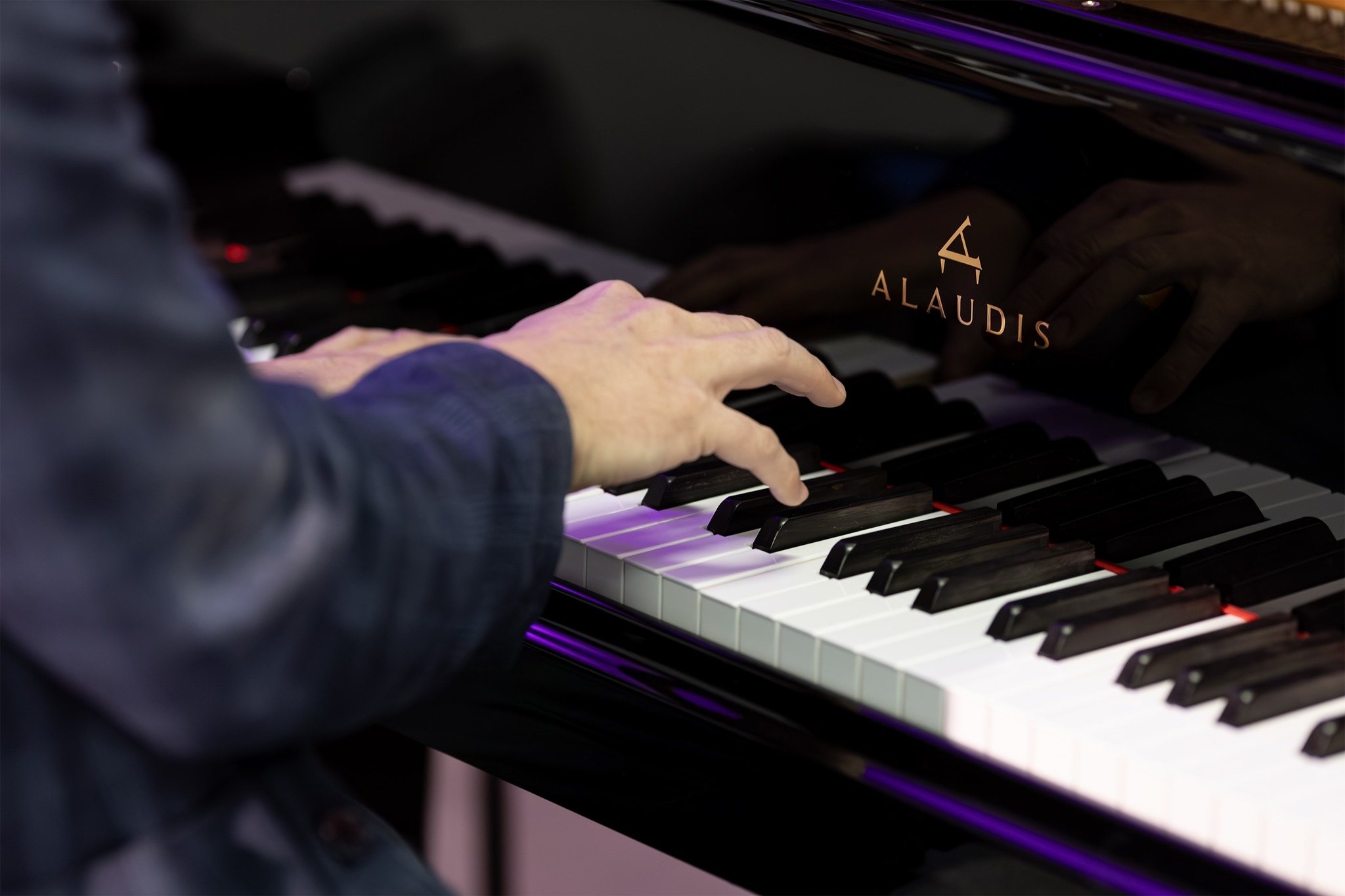
No set of measurements can replace a musician’s direct experience of the prepared instrument. A rehearsal explores its full dynamic range, from subtle pianissimo to powerful fortissimo. The pianist assesses how it responds to different touches and whether its tonal colour develops naturally. Bringing the artist’s expectations into dialogue with the technical settings can be a turning point in preparation. The pianist’s feedback guides the technician’s final adjustments.
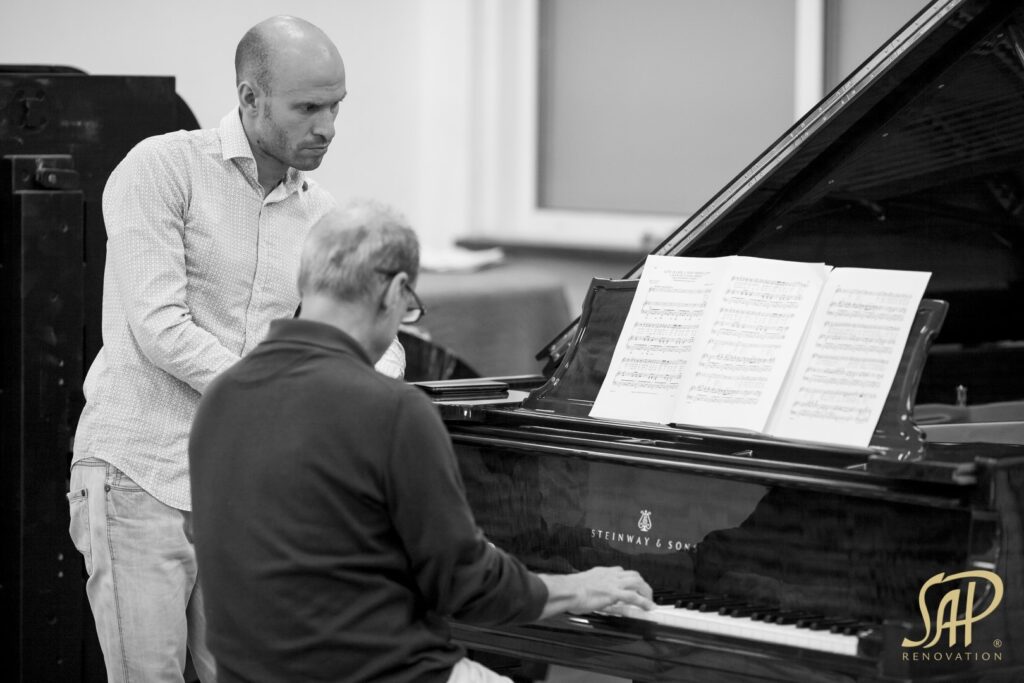
How pianists assess keyboard response and report differences in dynamics, repetition and tone
Pianists judge the instrument through the resistance felt beneath the fingers, the speed of the action’s return and the sound’s projection in the hall. Their comments often concern slight differences in touch between keyboard sections or individual notes that sound too bright. An experienced craftsperson can translate these impressions into specific mechanical adjustments.
The pianist continually evaluates the following aspects:
- Smooth transitions between registers, without abrupt changes in tonal colour.
- Action sensitivity under the lightest touch, particularly in pianissimo.
- Repetition speed in rapid trills and repeated notes.
- Even key resistance across the full compass.
The feedback is followed by further fine regulation and selective needling of individual hammers.
The concert hall changes the sound: room acoustics and final adjustments
A grand piano sounds different in an enclosed workshop from the way it projects into a large concert hall. Room volume, the audience and wall finishes all strongly influence perceived tone and loudness. Professional concert grand preparation therefore requires final adjustments on the stage itself. Voicing suited to the hall helps address unwanted resonances and improves sound projection. In this way, the instrument becomes an integral part of its architectural setting.
Transport after restoration and acclimatisation at the destination
Safe transport and adequate time to adjust to the new climate are essential to preserving the work already carried out. Changes in temperature and humidity during the journey cause the soundboard and pinblock wood to move. The grand piano needs several days to acclimatise at its destination before final tuning. Putting the instrument straight into stage use immediately after unloading is a technical mistake. Its wood must first reach moisture equilibrium with the surrounding air.
Quality control before the first performance: what must be checked?
The final technical inspection checks every component for stage reliability. A dedicated quality control department examines damper operation, pedal function, leg stability and the purity of every unison. Thorough piano quality control is intended to rule out unwanted knocks, clicks or damper faults during live performance. The comprehensive rebuilding service included in our restoration programme ensures the highest standard of workmanship. A written warranty supports the quality of the restored instrument.
From workshop to stage: when is the instrument truly ready?
A piano is ready for the stage only when its tuning is fully stable and the artist is completely satisfied. Reaching this point takes time, considerable technical expertise and several stages of collaboration between tuner and pianist. When browsing completed instruments for sale, it is worth remembering the many hours devoted to their final preparation. A fully realised instrument emerges from the combination of precise craftsmanship and artistic vision. Proper piano preparation for a concert allows the musician to focus entirely on musical expression.