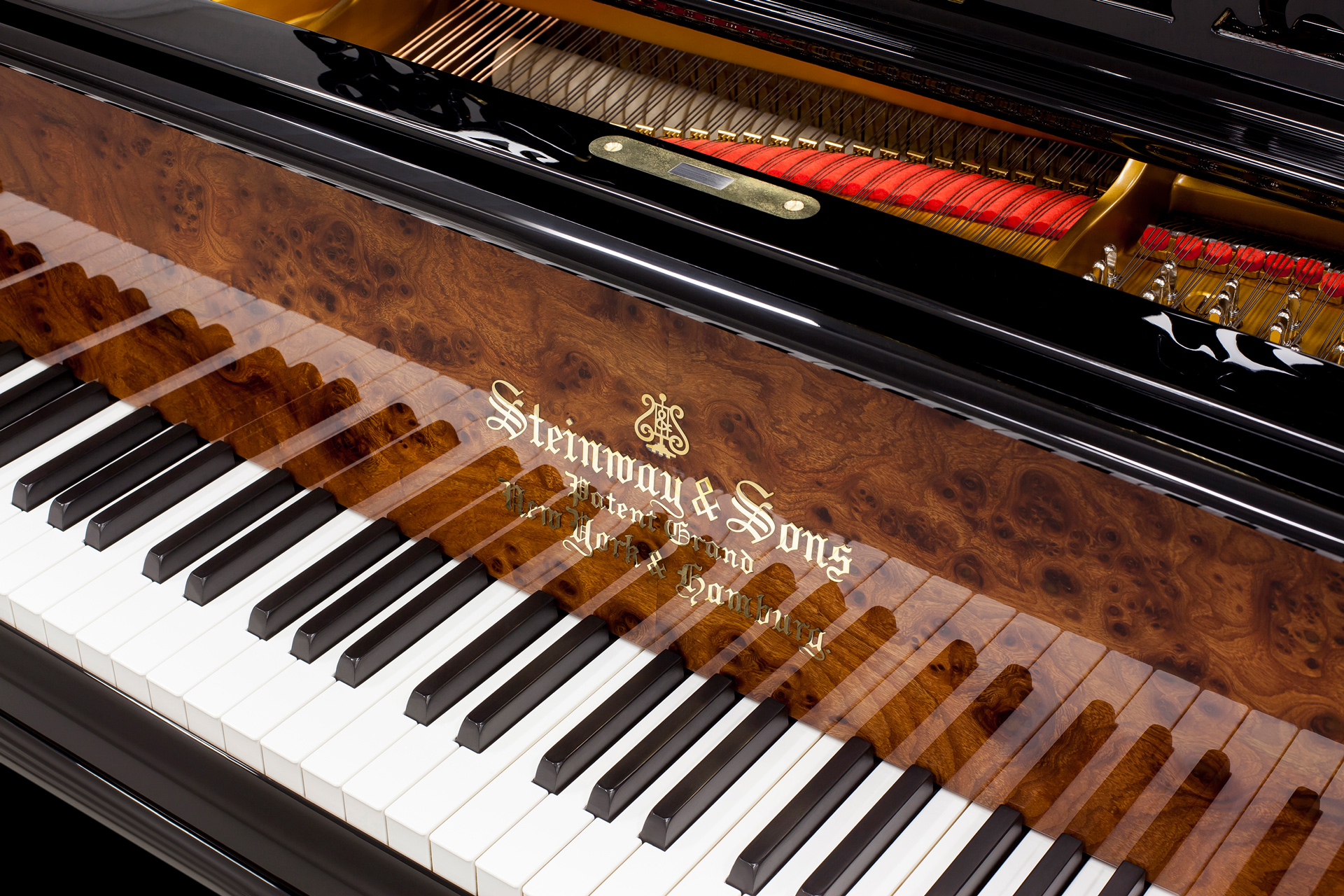

Every great musical instrument tells its own story, creating a special connection between performer and listener. Establishing a new brand rooted in master piano-building traditions takes courage, an original acoustic vision and exceptional precision. Birdsong has fascinated composers for centuries, symbolising lightness, purity and artistic freedom. Translating that natural wonder into the physical language of wood, steel and cast iron gives rise to a unique acoustic character.
Why does a new piano brand need a tonal language of its own?
A new piano brand needs its own tonal language because simply repeating established models leaves little room for an individual artistic identity or a distinctive place in the market. Today’s pianists seek an expressive palette that allows them to discover personal interpretative nuances in classical repertoire. Creating a unique acoustic profile requires careful thought about the relationship between construction and listening experience. Alaudis was founded to offer artists an exceptional degree of sensitivity and individuality. Its tonal identity becomes the makers’ signature, bringing a fresh perspective to tradition.
The skylark as Alaudis’s inspiration: translating a singing ideal into piano design
Giving structural form to the skylark’s song begins with designing acoustic elements that promote lightness and free resonance. The bird’s Latin name inspired the engineers behind the Alaudis models. To achieve an immediate response and a singing tone, they devised a resonant system intended to support the upper partials. Every detail of the wooden case is designed to encourage the natural development of sound without unnecessary damping. Discover the world of Alaudis, where art meets acoustic science.
Clarity of attack
A clear attack comes from carefully selected hammer felt hardness and a stable action at the instant of contact with the string. A responsive staccato keeps even the fastest scale passages distinct. The pianist can trust every finger movement to produce a clearly defined onset. This clarity helps prevent neighbouring tones from blurring in dense polyphonic textures. A well-defined beginning to each note provides the foundation for the musical phrase.
Natural phrasing
Natural phrasing depends on a direct, predictable dynamic response to variations in touch. The performer can shape a melodic line without effort or sudden jumps in volume. Smooth transitions between notes give the Alaudis grand piano a vocal quality. This flexibility invites subtle tonal shading and expressive timing in Romantic repertoire. The experienced musician feels in control of the singing character of every musical thought.
Projection without excessive brightness
Projection without unwanted harshness depends on balancing soundboard stiffness with string tension. High frequencies carry freely into the concert hall without tiring the listener. The designers have achieved a refined, pearly tone that projects clearly through an orchestra. The absence of aggressive metallic components allows sustained listening without fatigue. The sound fills the hall evenly and reaches the last rows of the audience.
Harmonic richness and long sustain
A rich harmonic spectrum and long sustain result from carefully coordinating the rim’s acoustic behaviour with the mass of the bridges. After the hammer strikes, the sound develops gradually rather than fading abruptly, revealing its upper partials. This produces a deep, layered tone with exceptional carrying power. A richer overtone palette gives even simple chords new shades of colour. Contact Alaudis to learn more about this distinctive acoustic quality.
Tonal identity begins with construction, not final voicing
Tonal identity takes shape during design and woodworking, long before the hammer felt is treated. Voicing refines and reveals qualities already built into the instrument. The geometry of the plate and rim determines the acoustic foundations. This individual profile makes the question explored in The Alaudis grand piano: how does it differ from traditional designs, and who is it for? a question about the philosophy of the craft itself. The final Alaudis sound emerges directly from the coordinated behaviour of its structural components.
The rim and its rigidity
Rim rigidity plays a vital role in retaining useful vibrational energy within the acoustic structure. The appropriate number of hardwood laminations, bonded under pressure, limits unwanted energy losses. Energy remains available to the soundboard rather than dissipating through the structure, supporting tonal projection. The substantial rim provides a stable foundation for static and dynamic loads. This helps preserve the instrument’s resonant qualities through decades of intensive use.
A soundboard of tone-grade spruce
The tone-grade spruce soundboard is the acoustic heart of the piano, amplifying vibrations transmitted by the strings. Wood from high-altitude forests selected for tonewood has closely spaced, even growth rings. Careful selection provides suitable sound-transmission properties throughout the board. A well-chosen soundboard gives the tone a distinctive warmth and refinement. The material is seasoned for many months under controlled humidity.
Ribs and soundboard crown
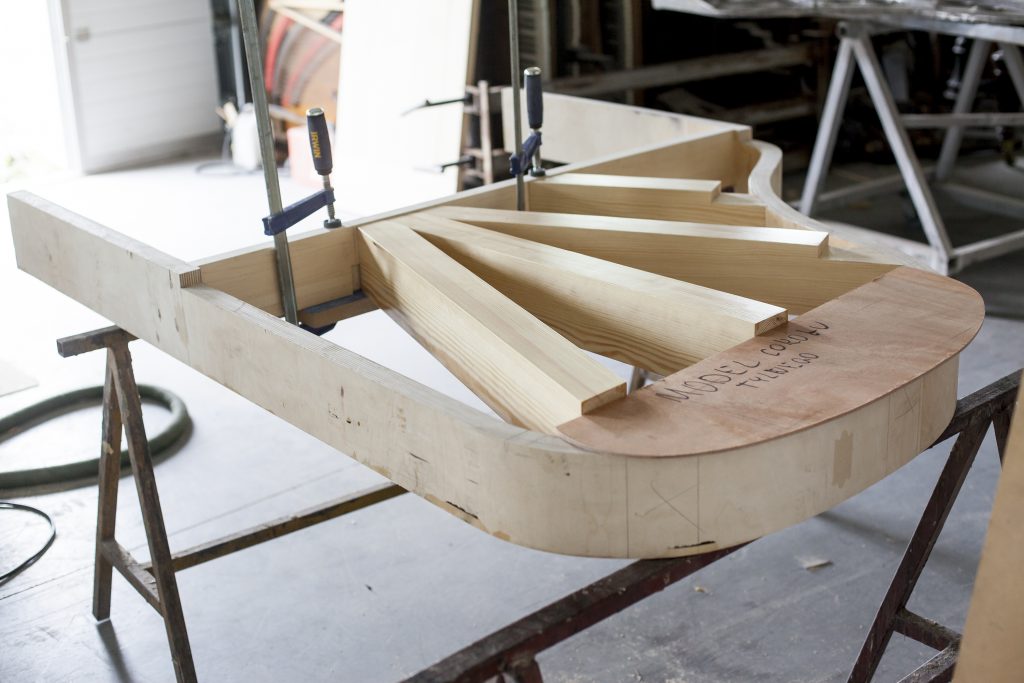
The ribs maintain the precisely shaped soundboard crown, providing resistance to the load imposed by the strings. The crown must withstand the downbearing transmitted through the bridges. Correct curvature supports efficient conversion of mechanical vibration into acoustic energy. Each spruce rib is tapered by hand within fractions of a millimetre. Appropriate elasticity helps prevent the soundboard from losing its crown over time.
Bridges: transmitting string energy
The bridges transmit string vibration directly to the soundboard. Made from hard beech or maple, they must withstand substantial localised pressure. Expertly crafted bridges support faithful energy transfer and avoid unwanted damping. Precisely installed bridge pins directly influence tuning stability and the clarity of the partials. This is one of the most critical elements of the entire construction process.
Scale design, strings and tension: the mathematics behind tonal character
The mathematical foundation of tone lies in carefully calculating each string’s length, diameter and tension. Errors in scale design create uneven loading and tonal inconsistency. Balanced tension protects the cast-iron plate against deformation. The designers devoted hundreds of hours to refining their calculations for coherence between registers. Carefully matched string tensions provide a firm basis for a stable, full sound.
Speaking lengths and wire diameters
String speaking lengths and wire diameters influence tonal flexibility and dynamic response. High-purity steel wire resists material fatigue and microcracking. Different sections require different gauges to maintain tonal continuity:
- Copper-wound bass strings provide a powerful, deep harmonic foundation.
- The middle section uses intermediate steel wire gauges to support supple phrasing.
- The highest treble uses thin wire with a rapid response.
Carefully graduating the wire gauges eliminates audible discontinuities between notes. Material suppliers are selected only after rigorous laboratory testing.
Inharmonicity and balance between registers
String inharmonicity is a physical phenomenon that must be controlled to achieve a coherent sound. Wire stiffness causes upper partials to deviate slightly from exact harmonic frequencies. Designers seek to minimise this effect by increasing speaking lengths where the construction permits. Appropriate compensation for inharmonicity supports clean chordal relationships. Balanced registers make even the most demanding piano repertoire comfortable to perform.
The Alaudis bass: building depth without losing clarity
Bass depth and clarity are achieved with longer strings and carefully chosen copper winding mass. This design avoids the dull, boomy tone that can obscure musical detail. Hand-wound bass strings respond immediately even to a gentle touch. The lower register remains distinct while providing a strong, clearly defined harmonic foundation. Every bass note retains a clearly audible fundamental.
Action and hammers: where the construction responds to the pianist’s gesture
The action and hammers form the direct link between the artist’s hand and the piano’s acoustic system. Precise adjustment of the levers controls the energy of each strike. In checking the condition of the piano action, specialists ensure that all moving parts operate smoothly and quietly. Keyboard sensitivity directly supports a rich range of articulation. Every touch brings a predictable, repeatable response.
Voicing: artistically shaping the instrument’s voice
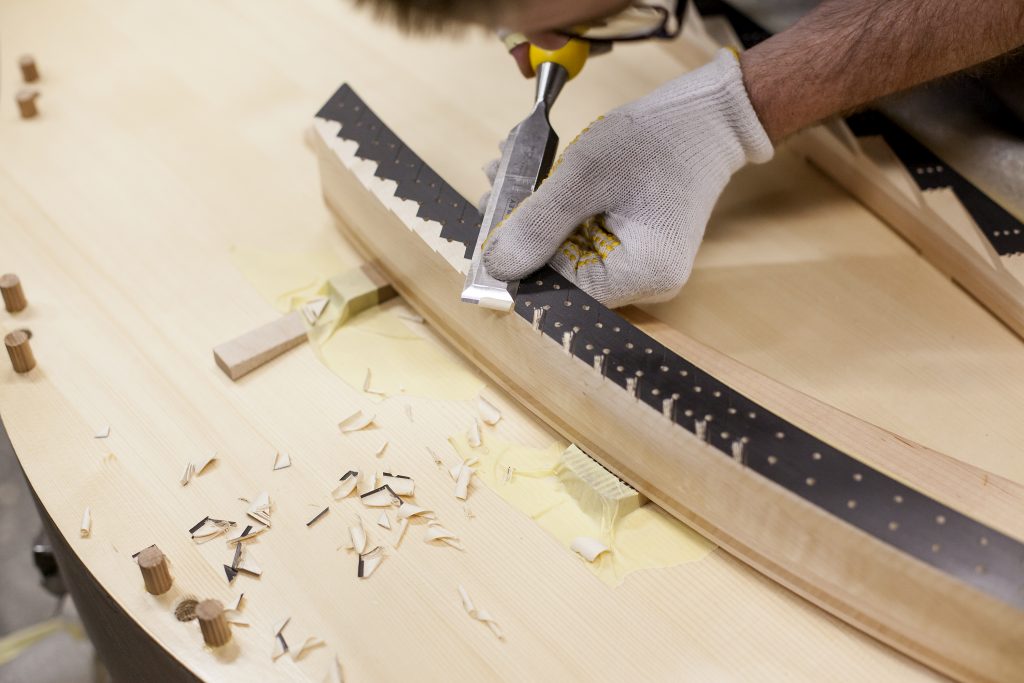
Voicing involves skilful needling and shaping of the hammer felt to establish the final tonal colour. It demands exceptional listening skills and years of craft experience. The technician works on the fibre structure to alter the hammer’s resilience at its contact with the string. This turns an unrefined sound into a varied tonal palette. Expert hammer voicing opens a wide field of expression to the pianist.
Individual attention to every hammer
Each hammer requires individual treatment of felt density according to its register. Bass hammers need greater flexibility, while treble hammers require appropriate firmness. Voicing needles are applied at different angles with great care. One ill-judged movement can permanently damage the felt’s elastic properties. After each series of needle insertions, the craftsperson tests the tone at different dynamics. A professional acoustic restoration workshop provides the expertise this work requires.
Evening out tone between registers
Evening the registers removes abrupt changes in colour between bass, tenor and treble. The voicer creates a coherent tonal palette across the keyboard. Refined tone emerges from many hours of listening and adjustment. Carefully balanced voicing gives coherence to every chord spacing. As the melody moves between registers, the listener hears continuity rather than an intrusive change of colour.
Final voicing by Peter Salisbury
Peter Salisbury’s final voicing draws on a long tradition of British piano craftsmanship at the highest level. His finishing touch gives the instrument its distinctive singing character. Peter Salisbury’s work is central to the project’s success. Experience gained with leading pianists informs the final tonal result. With Salisbury leading the team and guiding the work, his voicing brings exceptional depth and refinement to the instrument. The contribution of this world-class specialist crowns many months of production.
How can a grand piano retain its singing quality from pianissimo to fortissimo?
Maintaining a singing quality throughout the dynamic range is attributed to the hammer felt’s linear response to striking force. In the quietest passages, the tone remains clear, distinct and capable of carrying. At full power it does not become strident or overdriven. This singing character retains its refinement at every level of the pianist’s expression. A well-balanced dynamic response allows powerful dramatic climaxes to develop.
Why should Alaudis not be presented as a copy of Steinway, Bösendorfer or Bechstein?
Alaudis should not be described as a copy of an established maker because it follows an original acoustic concept. Moving beyond existing formulas introduces a fresh quality to the concert piano market. Although inspired by the finest European traditions, it develops its own sonic and aesthetic identity. The Alaudis grand piano exemplifies contemporary engineering with a distinctive purpose. This Polish piano maker demonstrates that a new instrument can have a character entirely its own: an independent, distinctive Polish grand piano.
How do pianists and technicians assess a new piano’s tonal identity?
They assess tonal flexibility and the response to complex articulation. Tests examine subtle tonal shading and tuning stability. The instrument’s capacity for corrective voicing in different hall acoustics is equally important. A qualified quality control department carries out these detailed procedures. The final judgement belongs to pianists evaluating clarity and individual tonal character. Their feedback supports continuing improvements to the construction.
Consistency without mass production: preserving the brand’s identity in every instrument
Consistency comes from rigorous adherence to technical standards and precise craftsmanship. Every instrument is built under the same material and humidity controls. Although wood is a natural material, close attention to tolerances preserves the intended tonal profile. Each premium grand piano maintains the brand’s distinctive acoustic qualities. The tonal identity is carried into every new instrument, with attention to detail underpinning the promise of quality.
Alaudis: a distinct voice in European piano craftsmanship
Creating a tonal identity is a fascinating process that unites art, craftsmanship and science. Alaudis demonstrates how passion and the courage to pursue an individual ideal of tone can produce remarkable acoustic results. Inspiration from nature and masterful voicing come together in an instrument of exceptional singing quality and refinement. The history of SAP Renovation reveals the tradition and development behind the brand. Please contact an SAP Renovation specialist to experience this instrument for yourself.