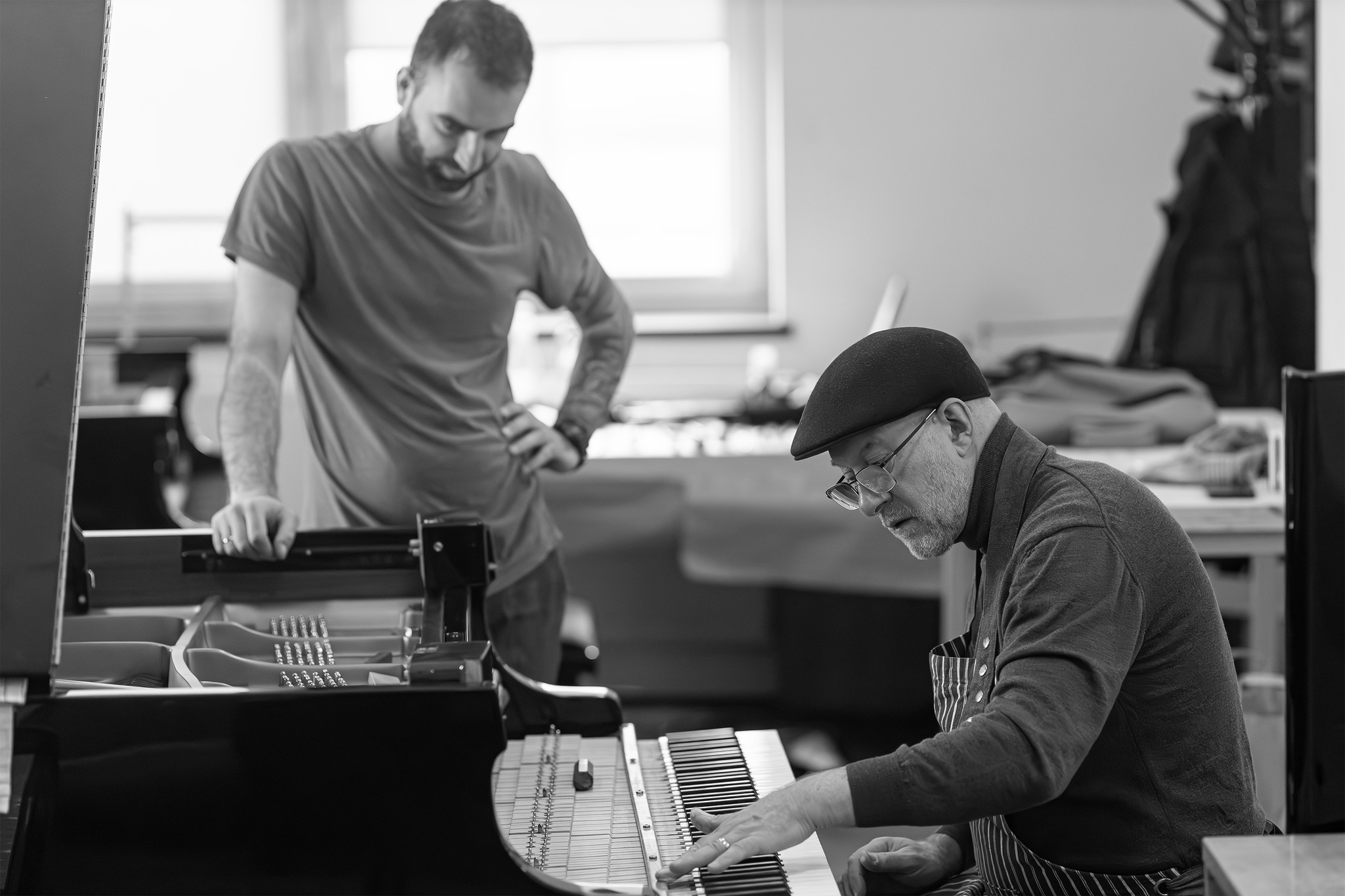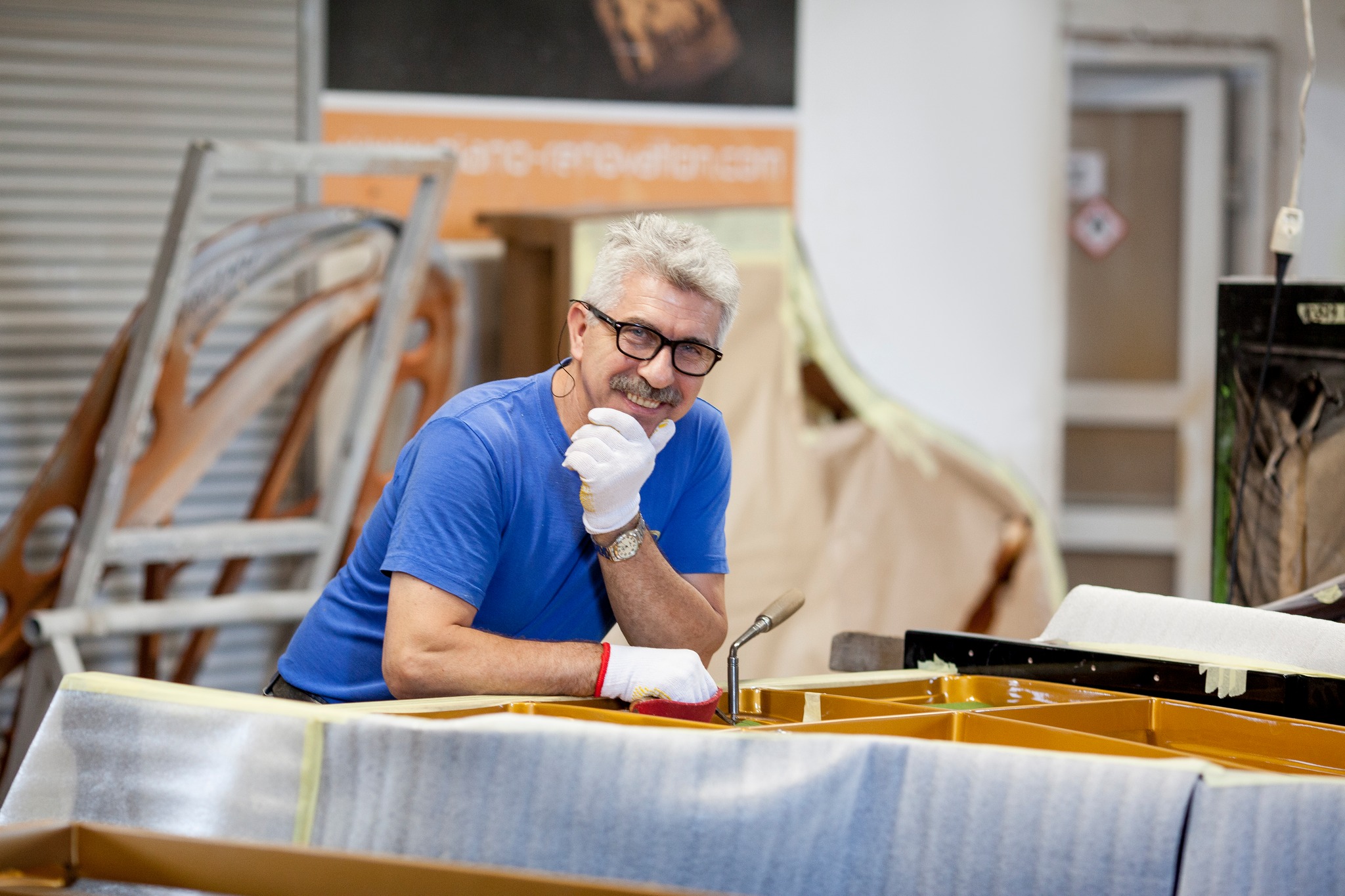
A piano is an instrument made of extremely delicate materials such as wood, steel, and metal, which are highly sensitive to climate fluctuations. Optimal storage conditions for these noble instruments are typically 18–22°C with relative humidity maintained between 40–65%. Any slight deviation from these strict parameters triggers a predictable and destructive chain of physical damage to the instrument’s structure. Proper preventive care combined with regular tuning can significantly extend a piano’s lifespan by decades while preventing extremely costly repairs.
The Influence of Humidity and Temperature on Pianos and Grand Pianos – Why Climate Matters
Even though the wood used in the instrument was harvested many years ago, it remains a biologically active material that continuously responds to environmental changes. This phenomenon, called hygroscopicity, means that the wooden fibers constantly exchange moisture with the surrounding air. When humidity in a room rises sharply, the wood absorbs water and expands, a process known as swelling. Comprehensive restoration services can repair the damage caused by these natural processes, which may distort the geometry of the entire structure.
Additionally, the cast-iron frame must withstand the enormous tension of the strings, ranging from 15 to 30 tons. This generates tremendous internal stress. Uneven drying of the wood’s surface relative to its core creates massive stress gradients, leading directly to micro-cracks. Seasonal changes, such as freezing temperatures outside and high indoor heating, unfortunately create ideal conditions for structural collapse.
Wood, Strings, and Soundboard – How Humidity Changes Affect Tuning
During periods of significant dryness, when humidity drops below 40%, the surface layers of wood lose moisture much faster than the inner layers. This causes the outer layer to shrink, generating enormous shear forces that tear the fibers along their radial lines. The soundboard, made of thin spruce, is particularly vulnerable: under dry conditions, it can crack longitudinally and lose its acoustic properties. A professional replacement or restoration of the soundboard may be necessary if cracks distort the physics of sound waves or compromise the bridges that transmit vibrations.
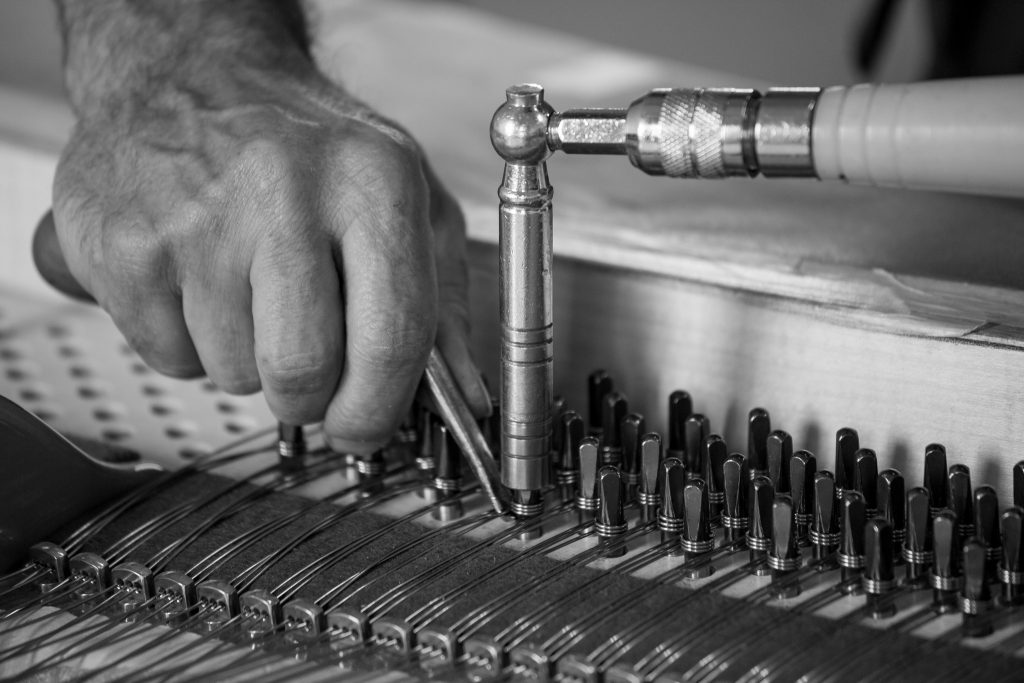
Humidity also affects pianos through loosening of tuning pins in a drying pinblock, making it impossible to maintain stable tuning. Steel strings react by losing tension, which directly causes noticeable detuning. In excessively humid conditions, wooden parts swell and can jam the precise mechanisms, making smooth movement of keys and dampers difficult.
Early Warning Signs – When Humidity Starts to Harm Sound and Structure
Before visible cracks appear, the instrument begins signaling problems through subtle changes in its sound. One of the first signs is a flat tone, which clearly indicates a loss of flexibility in the soundboard. Metallic or buzzing sounds may suggest that tiny cracks in the wood are vibrating unsynchronously. Professional restoration of piano frames is often recommended when early signs of corrosion or structural instability appear.
Other warning signs include characteristic creaks when the temperature changes. If keys do not return smoothly to their resting position or respond with delay, it indicates that the felts in the mechanism have swollen due to moisture. Failure to maintain pitch after tuning is an alarming sign that the tuning pins are working in oversized holes.
Cracks, Deformations, and Corrosion – When Piano Repair Becomes Necessary
The critical point occurs when soundboard cracks exceed 10 mm and create unwanted parasitic resonances. At this stage, piano repair and restoration become absolutely necessary to restore the instrument’s original structural integrity and value. Professional workshops can remove corrosion and, if needed, weld micro-cracks in the metal frame. A drying pinblock may delaminate or crumble, making the tuning pin holes too loose and requiring costly replacement.
Visible rust on the strings in the form of a brownish coating indicates prolonged exposure to overly humid conditions. Loosened copper windings on bass strings are irreversible damage, requiring immediate replacement of the entire string set. The appearance of mold or fungus in the form of black spots on the finish is the final warning before total biological degradation of the wood.
Piano Restoration and the Consequences of Climatic Neglect – Scope and Realistic Possibilities
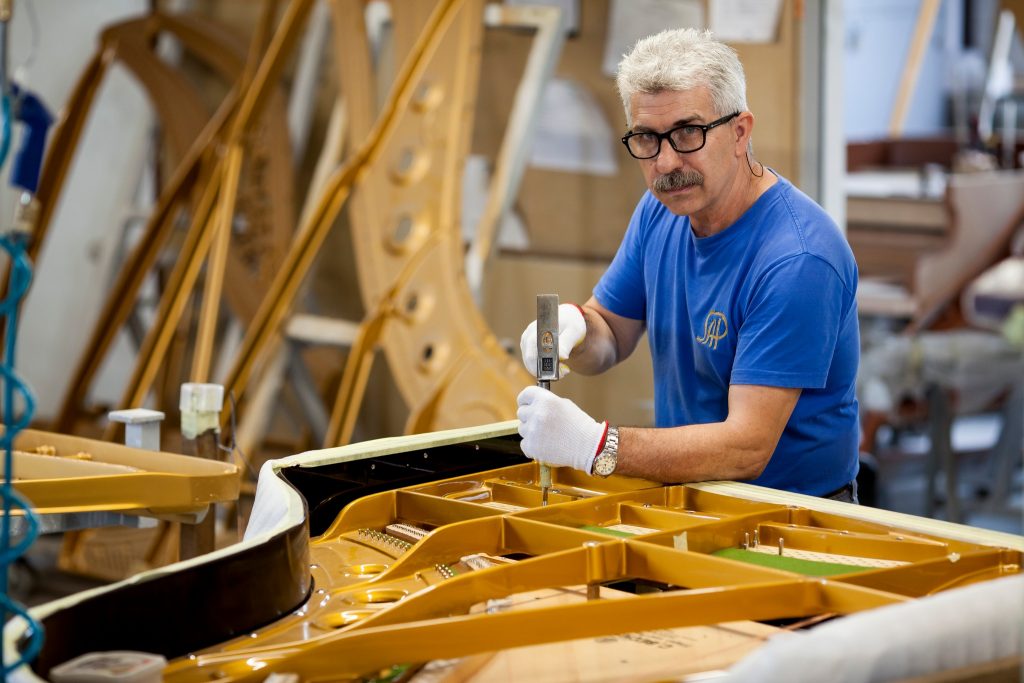
Proper piano restoration is a complex process aimed at restoring full acoustic and mechanical integrity after years of neglect. The scope of work usually includes sandblasting the cast-iron frame, filling cracks in the soundboard or completely replacing it with a new spruce element. Technicians must carefully assess the condition of the pinblock, as its replacement is one of the most difficult and expensive conservation procedures.
During the overhaul, the entire string set and tuning pins are often replaced, using larger-diameter pins for a better fit. The mechanism requires replacement of worn felts and leather parts, as well as precise geometric regulation of all components. Even severely warped elements can be repaired if the wood’s structure has not been completely destroyed by decay. Careful shaping of hammer hardness and elasticity during voicing allows recovery of a rich and noble tone.
Restoring the Piano Cabinet – Veneer, Lacquer, and Wooden Elements Under the Influence of Moisture and Temperature
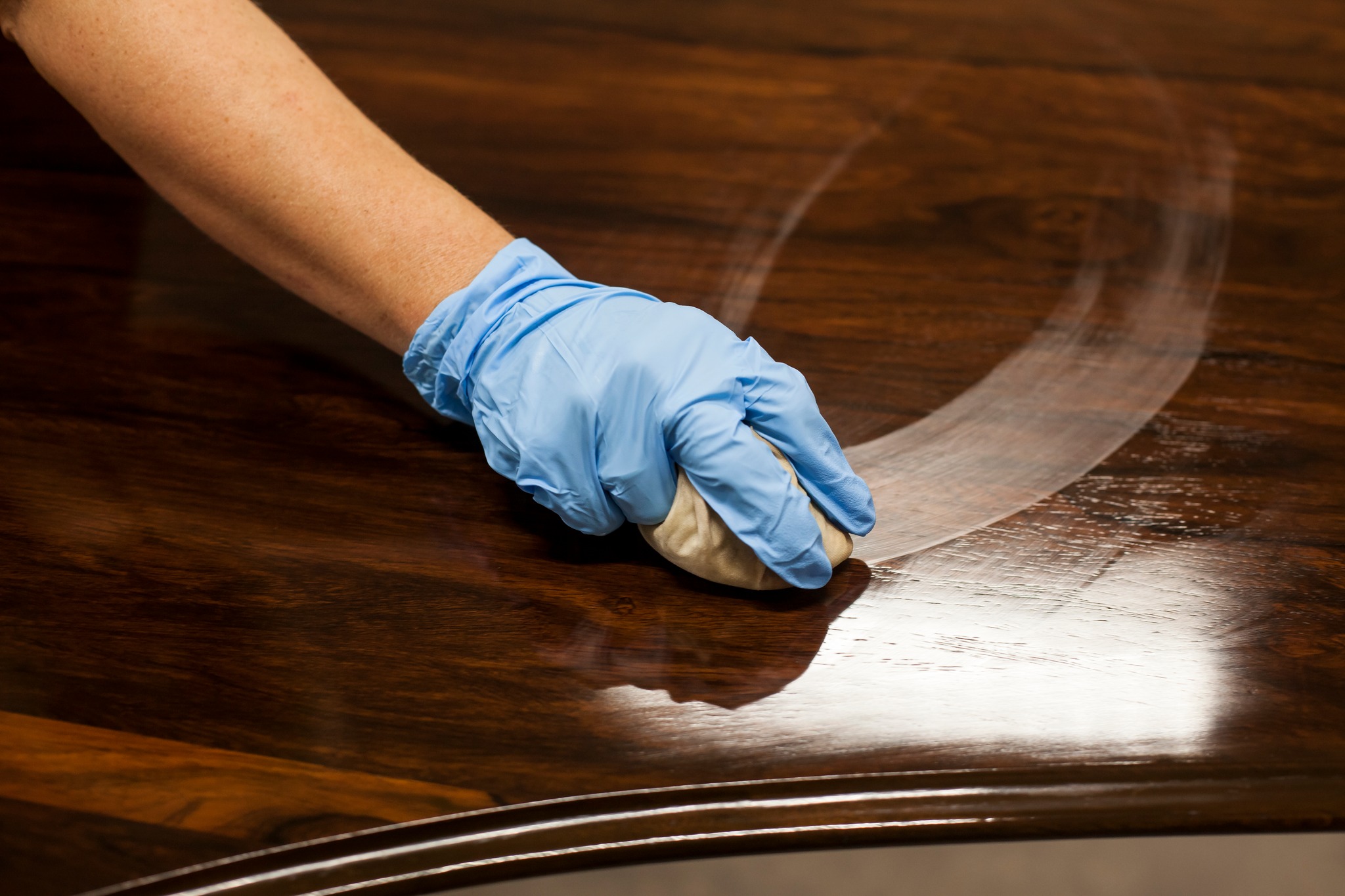
Professional cabinet restoration begins with a detailed assessment of the finish and decorative veneer. Many examples of restoration work illustrating the scope of possible aesthetic interventions can be found on the SAP Renovation website. If the lacquer is damaged, it may need to be mechanically removed through sandblasting or shot-blasting with strictly controlled grit. Veneer cracks are repaired by inserting wooden wedges using epoxy resin and then carefully leveling them. The lacquer process is multi-layered and involves applying an anti-corrosion primer, a colored base coat, and a clear topcoat. Owners can choose from high-gloss finishes, matte open-pore options, or traditional hand-applied French polish. Every restoration procedure is documented photographically to ensure conservation continuity and allow tracking of the woodworking progress.

Preventive Care Instead of Costly Piano Restoration – How Stable Conditions Protect the Instrument for Years
Preventive maintenance is the only effective strategy to save significant funds and genuinely extend the lifespan of a musical instrument. The foundation of protection is maintaining proper humidity. It is also crucial to avoid direct sunlight and position the piano at least 1.5 meters (5 feet) away from heat sources. Regular visits from a technician and tuning at least twice a year allow early detection of structural problems.
Vases with water should never be placed on the instrument, as this can cause string rust and cracking of the soundboard. Stable temperature and proper placement in the central part of the home are the best guarantees that the instrument will retain its qualities for generations.