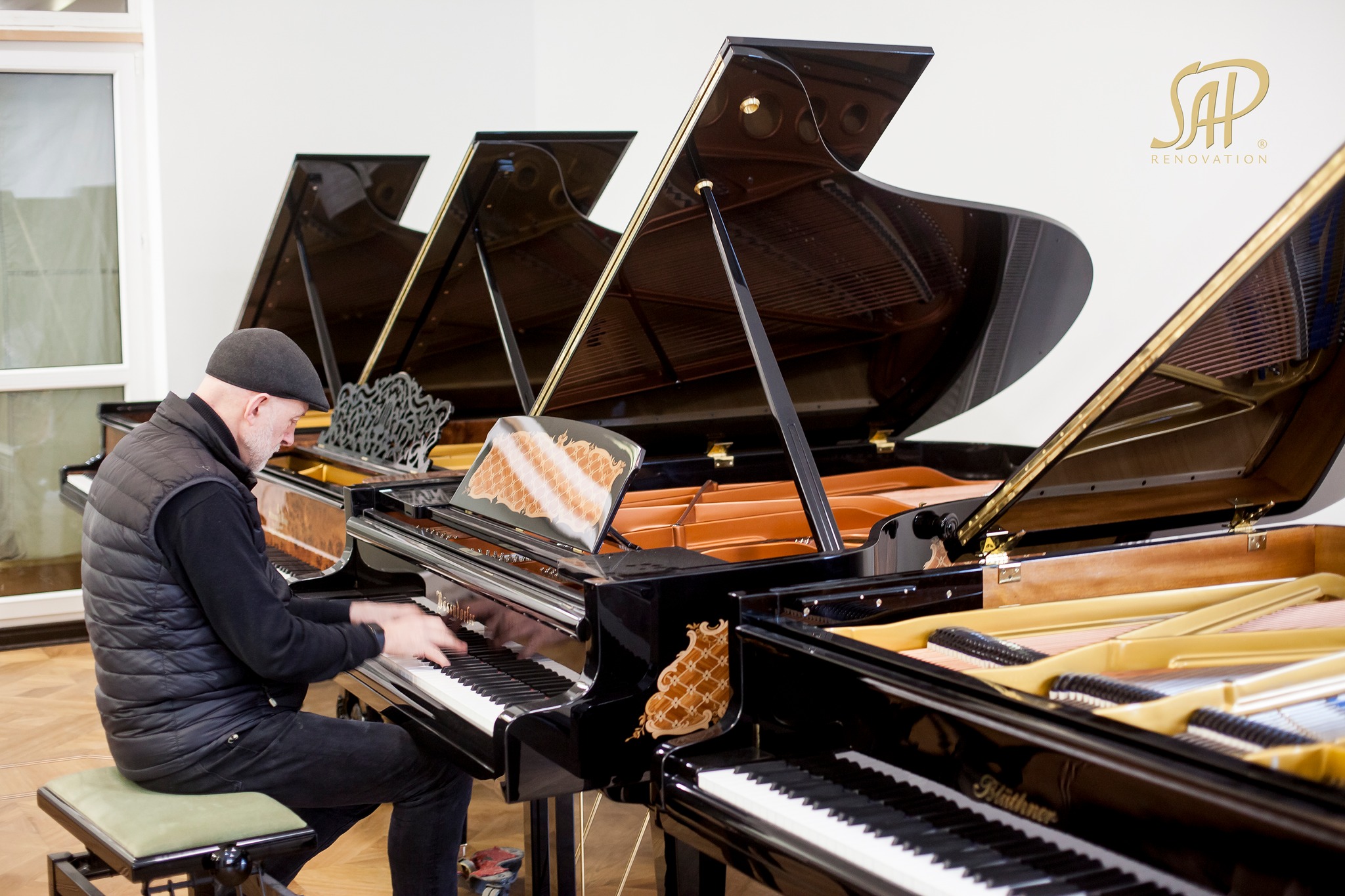

An acoustic piano is a complex electromechanical system whose tuning stability depends on the delicate balance of forces acting on the cast-iron frame and wooden soundboard. Maintaining the A-440 Hz standard is not just a matter of sound aesthetics but a technical requirement dictated by the physics of steel, wood and felt. Professional servicing ensures correct harmonic intervals and full mechanical efficiency — both essential for developing musical hearing and technique.
Why regular tuning is the foundation of great tone
Sound generation relies on precise string tension, which gradually weakens over time and use. As tension drops, pitch becomes unstable, tone loses clarity, and colour becomes dull. An unmaintained piano produces false intervals, dull resonance and weak harmonic coherence. Regular tuning restores proper physical parameters, allowing the soundboard to vibrate freely.
How sound deteriorates without regular tuning
The first sign is subtle pitch “wavering,” most audible in unisons. The bass becomes muddy, the treble sharp and unpleasant. When partials fall out of alignment, even correctly played chords sound dissonant. Long-term neglect can drop the pitch far below A-440 Hz, permanently altering the piano’s tonal character.
Tuning and instrument longevity
Regular service protects acoustic quality and structural integrity. Balanced tension prevents unpredictable stress on the frame and wooden structure, reducing the risk of soundboard cracks. Restoration is significantly more expensive than preventive maintenance.
How often should a piano be tuned?
- minimum standard: once a year,
- schools, institutions: every 6 months,
- new pianos: up to 4 tunings in the first year,
- concert & studio instruments: before every performance or session.

Factors affecting tuning frequency
- humidity fluctuations,
- intensity of playing,
- age and condition of the pinblock,
- material quality.
When to tune – expert recommendations
Ideal timing: after climate stabilisation at the start and end of heating season. Consistency is key.
DIY tuning — is it possible?
Technically yes. Practically: strongly discouraged.
Risks include:
- string breakage,
- damaged tuning pins,
- possible frame damage from uneven torque.
Step-by-step tuning process
- Inspection and removal of cabinet parts.
- Installing felt strips or mutes.
- Setting the temperament octave.
- Extending tuning across the keyboard.
- Eliminating beats, verifying intervals.
- Pedal check and reassembly.

Duration: 1.5–2 hours.
Pitch raise → fine tuning
Severely flat instruments require an initial pitch raise, followed by precise unison tuning and stabilisation of pins.
What the technician listens for
- noise, rattles, sympathetic vibrations,
- proper torque of tuning pins,
- bridge integrity,
- correct damper action.
Common tuning issues
- loose tuning pins,
- false strings,
- soundboard cracks,
- corrosion,
- unregulated mechanism.
Preventing tuning problems
- maintain humidity (45–60%),
- avoid heaters, fireplaces, strong sunlight,
- regular technical checks.
Signs your piano needs repair
- slow-returning keys,
- squeaks or knocks in the action,
- uneven keyboard level,
- rapid pitch drift after tuning.
Tools required for tuning
- tuning hammer,
- mutes,
- tuning fork or ETD,
- felt strips,
- basic regulation tools.

Tuning hammers — variations
Professional-grade steel tools with precise star heads and rigid or telescopic handles. Cheap tools damage pins.
Additional useful accessories
- lubricants for string contact points,
- hygrometers,
- tuning apps for spectral analysis.
How climate affects piano tuning
Low humidity → wood shrinks → pitch drops.
High humidity → wood swells → pitch rises.
Temperature affects string expansion mildly but humidity remains the dominant factor.
How to protect the piano
- monitor humidity,
- avoid heat sources and sunlight,
- consider an internal humidity-control system,
- close the lid when not in use.
Care between tunings
- dust with a soft cloth,
- lightly damp cloth for keys,
- avoid liquids near the piano,
- internal cleaning left to technicians.

Why regular maintenance matters
Regulation, cleaning and protection extend lifespan and enhance transmission of vibrations.
Differences between tuning an upright and a grand
Different action principles, access points and bass behaviour require professional adaptation of tuning technique.
Modern tuning technology
ETDs provide analytic support but cannot replace the technician’s ear, experience or manual precision.
Professional tuning with SAP Renovation

Before the visit:
- remove items from the piano,
- provide good lighting,
- ensure a quiet environment,
- prepare notes about irregularities.
SAP Renovation guarantees perfect tuning, mechanical precision and long-term reliability of your instrument.