
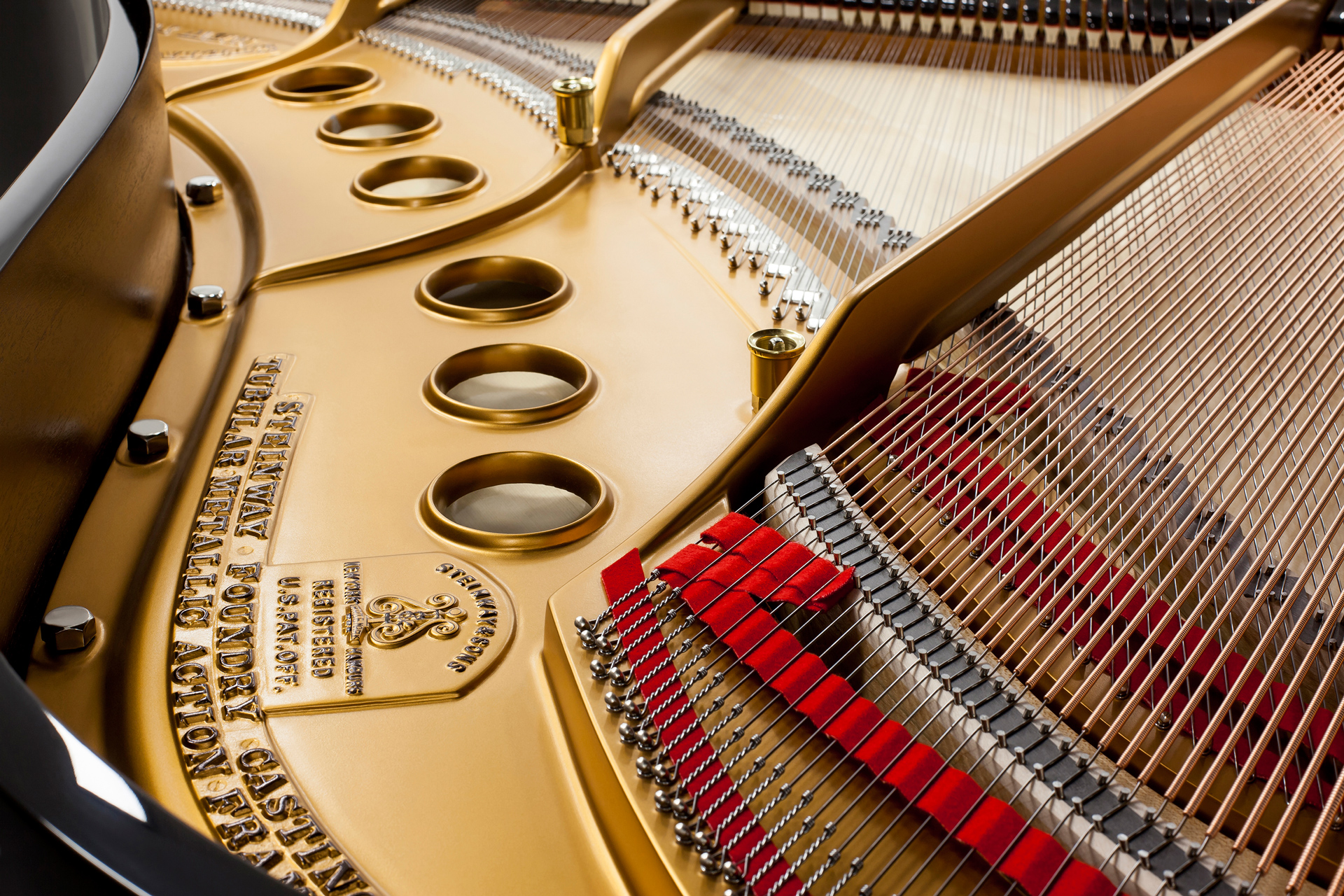
The grand piano captivates music lovers with the power of its sound in concert halls. That sound begins when a hammer strikes a steel string inside the instrument. The soundboard gives strength to the sound waves and radiates the vibrations into the hall. Without it, the strings’ vibrations would fade almost inaudibly, lacking a sufficient surface to radiate sound. This wooden structure shapes both the colour and the duration of each note. Its central role in creating the piano’s voice is why so many craftspeople call it the heart of the instrument.
What does the soundboard do, and why are strings alone not enough for a grand piano to sound at full power?
When struck by a hammer, a string moves through the air, setting only the air particles immediately around it in motion. This is where piano acoustics rely on a component with a surface area of more than a square metre. The wood receives vibrations from the strings and radiates sound towards the audience. Its surface acts as a diaphragm, moving the air within the concert hall. Without this process, the instrument would produce little more than the clatter of metal and wood, without the benefit of resonance. Only the interaction between the strings and the wood gives the pianist’s playing its power and fullness.
Soundboard spruce — which properties of the wood matter for acoustics?
For centuries, master piano makers have chosen spruce from European mountain slopes for this component. Soundboard spruce has a cellular structure that helps vibrations travel along the grain. It combines low weight with resistance to the forces generated by the many tonnes of string tension within the instrument. Craftspeople value the speed at which an impulse travels along its cellulose fibres. Its resonant qualities depend on the absence of knots and the regularity of its growth rings. Trees from colder regions develop evenly spaced rings, visible in the cross-section of the trunk.
Selection, seasoning, grain orientation and the stiffness-to-weight ratio
Selecting suitable timber requires a maker to understand how a tree grows in its natural environment. Trees are selected in winter, when sap activity is at its lowest. After felling, the wood is seasoned for years to stabilise its moisture content. Craftspeople assess its suitability for manufacture against three criteria:
- The arrangement of the growth rings within the wood
- The length of time the timber has been seasoned in storage
- The component’s stiffness-to-weight ratio
Choosing the right combination of these properties is crucial to successful restoration of the acoustic assembly in a piano workshop. It enables the soundboard to resist deformation while retaining its ability to vibrate.
Soundboard crown and ribs — how does the structure behave under string load?
A piano soundboard is not flat: it has a shallow arch, known as the crown, rising towards the strings. Spruce ribs reinforce it from below to maintain this profile. The crown resists the strings’ downward pressure, which places a load equivalent to hundreds of kilograms on the bridge. The ribs maintain the shape of the wood and distribute vibrations both along and across the board. The balance between string forces and the resistance of the crown determines the instrument’s dynamic response. If this profile is lost, the tone loses carrying power and the piano’s volume diminishes.
Bridges as the link between the strings and the soundboard
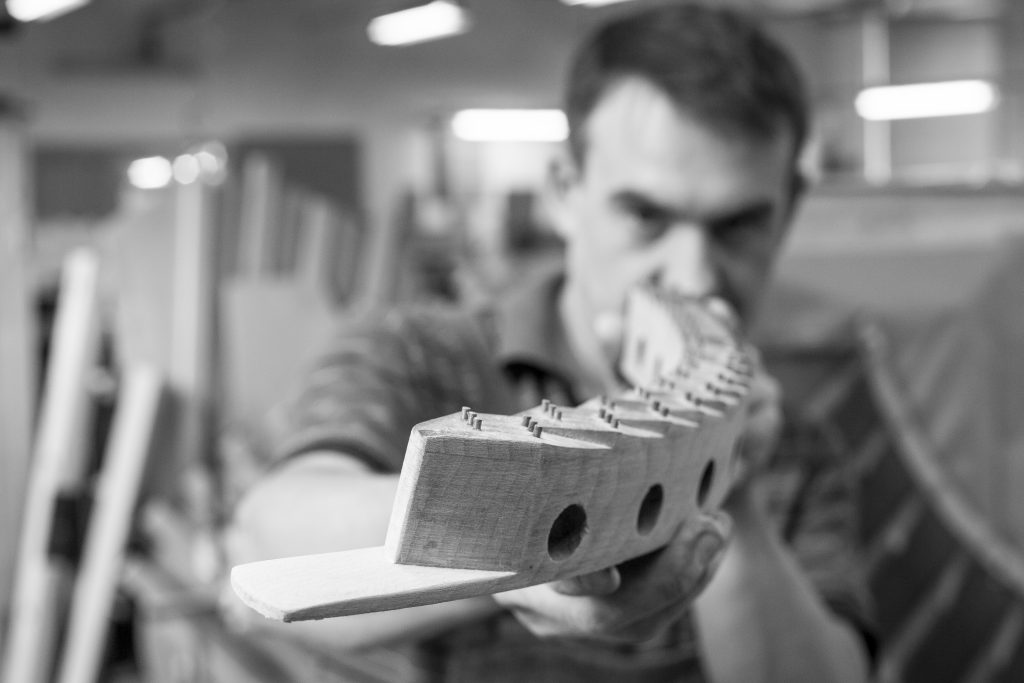
Bridges made from beech or hornbeam form the link in this system. They sit on the soundboard and receive the pressure exerted by the strings as the pianist plays. Bridge pins determine the strings’ path and their angles of deflection across the instrument’s scale. Downbearing ensures that vibrations are transferred into the body when the hammers strike. If a bridge loses contact with the board, professional soundboard repair can help. Failures in the glue joint in this area cause unwanted noises and reduce sustain.
Why does precise contact between the bridge and soundboard affect energy transmission?
The underside of the bridge must meet the soundboard without gaps along the joint. Even a gap measuring a fraction of a millimetre acts as a barrier to vibration. Poor contact reflects vibrational energy, reducing the energy transferred from the string before it can produce resonance. Craftspeople use hide and bone glues to create a joint that sets glass-hard. A joint of this kind transmits vibrations without damping the instrument’s frequencies. Precision in assembly gives the piano a clear tone and a rich spectrum of overtones in the hall.
A cracked soundboard — when is a crack a cosmetic issue, and when does it affect the sound?
Changes in indoor humidity cause wood to contract during winter. Gaps can then develop along the grain of the spruce. A crack becomes an acoustic defect when the ribs separate from the soundboard. The vibrating board can then strike against a rib, producing a buzz as notes are played. If the ribs continue to hold the structure securely, the gap is only a visual concern for the owner. Assessing the component requires expert knowledge and careful listening tests in a restoration workshop.
Repair the original soundboard or make a new one — what determines the decision?
During restoration, the specialist checks whether the soundboard has retained its crown. If the wood still has its elasticity, cracks are repaired by inserting spruce shims. These fill the gaps and restore the board’s structural integrity. If the crown has collapsed, restoring the old wood will not achieve the desired result. The solution is then a new soundboard, made from scratch in the workshop. This step restores the instrument’s dynamics and the tonal colour it possessed when it left the factory.
How is a new soundboard made at SAP Renovation?
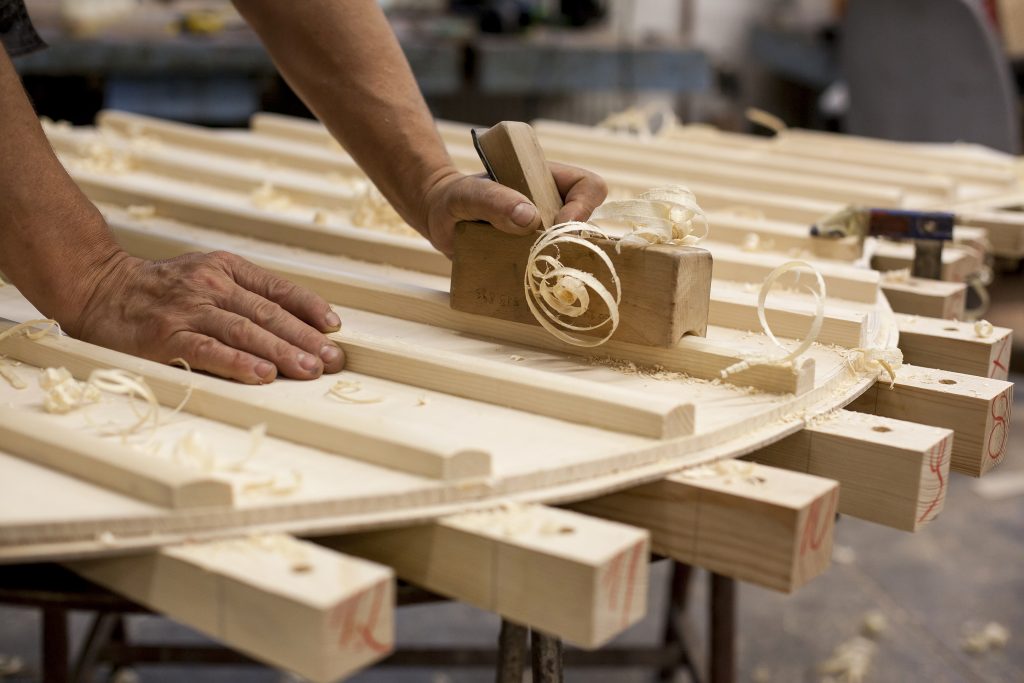
Work begins with measurements of the case geometry and an analysis of its specifications. Specialists select spruce boards according to grain direction and density. The boards are glued together in a press shaped to the soundboard’s crown. The team then fits the ribs, which give the structure resilience under load. Using a template, the bridges are positioned to within fractions of a millimetre. Piano owners can learn more about the process by contacting the SAP Renovation team through Customer Service.
The Alaudis soundboard — how has restoration expertise been applied to building a new instrument?
The experience gained from restoring thousands of instruments led to the creation of the Alaudis grand piano, built from the ground up in Poland. The project brings together traditional craftsmanship and advances in acoustic science. Its soundboard is made from spruce that has undergone vibration testing at an acoustics research centre. The story Behind the scenes of the Alaudis project gives music enthusiasts an insight into its construction. The soundboard’s design ensures tuning stability and a full, sustained tone during performances by leading pianists. In this way, restoration expertise has brought a new work of the piano maker’s art to life.
A spruce soundboard remains the heart of the instrument because it converts the energy of the strings into sound. Its quality depends on timber selection, the precision of the ribs and the preservation of its crown. Looking after the soundboard allows generations of music lovers to enjoy the piano’s full voice. Maintaining suitable room humidity protects the wood against cracking and loss of tone. Both the restoration of a historic instrument and the creation of a new one demand mastery in working with spruce. Thanks to the knowledge of skilled craftspeople, the grand piano retains its soul and continues to captivate audiences in concert halls.